
Research — August 2026
The For You ranking function.
X open-sourced its recommendation code. I read it, wrote the scoring function out in full, and checked every constant against the source.
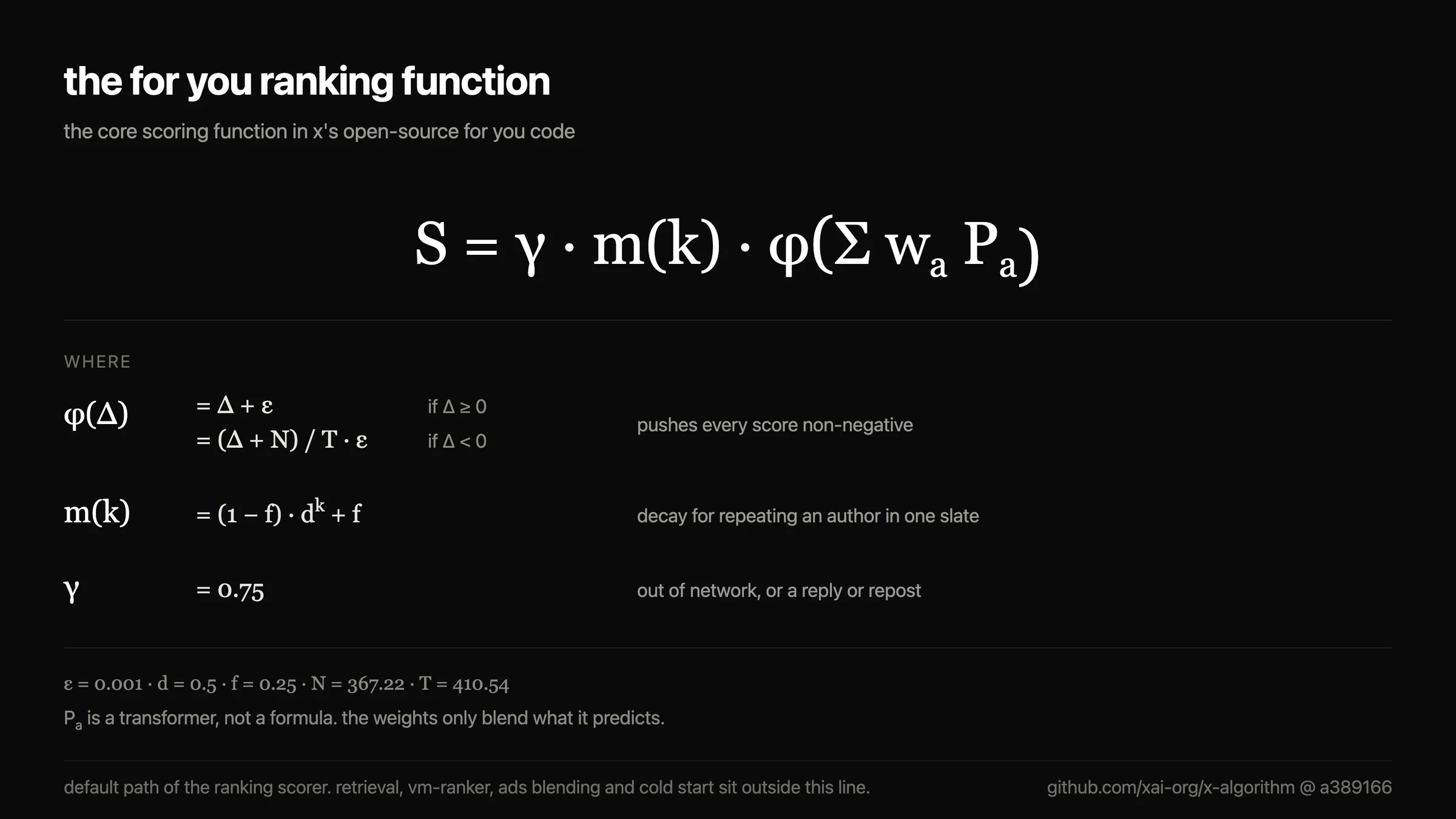
The full derivation, the constants and the order-of-operations subtlety are in EQUATION.md. Drag it sideways to read it.Source on GitHub
What it is
Ten findings, one equation, and a model you can open.
X released its For You recommendation code on 13 August 2026. Ranking code is useful to read directly, but some of it — the score offset, the author-diversity decay, the out-of-network gates — is easier to reason about as equations than as Rust spread across files. So the notes write the scoring function out in full, verify every constant against the source, and put the arithmetic in a spreadsheet where the formulas are live.
Ten findings, each carrying its own file and line number. The complete ranking-stage function, its constants, its offset map, its filter gates, and a section on what genuinely cannot be written in closed form. A six-sheet workbook holding all 214 calculations as live formulas, nothing flattened. Two charts. The scripts that regenerate both the workbook and the charts. And a sources file naming the pinned upstream commit and each of the twelve files referenced.
Its own framing, from the readme: this is careful reading, not growth advice — and if anything in it disagrees with the code, the code wins.
One finding, priced
The same predicted reply, weighted four times over.
A predicted reply is weighted at 5.0. If the reader mutually follows you and the post is an original — not a reply, not a retweet — a boost of 15.0 is added, and the weight becomes 20.0. The notes call it the single largest author-controllable multiplier in the scoring path.
Two files, three line ranges, one predicate. That is the shape of all ten findings: a claim, the constant it rests on, and the place in the code you can check it.
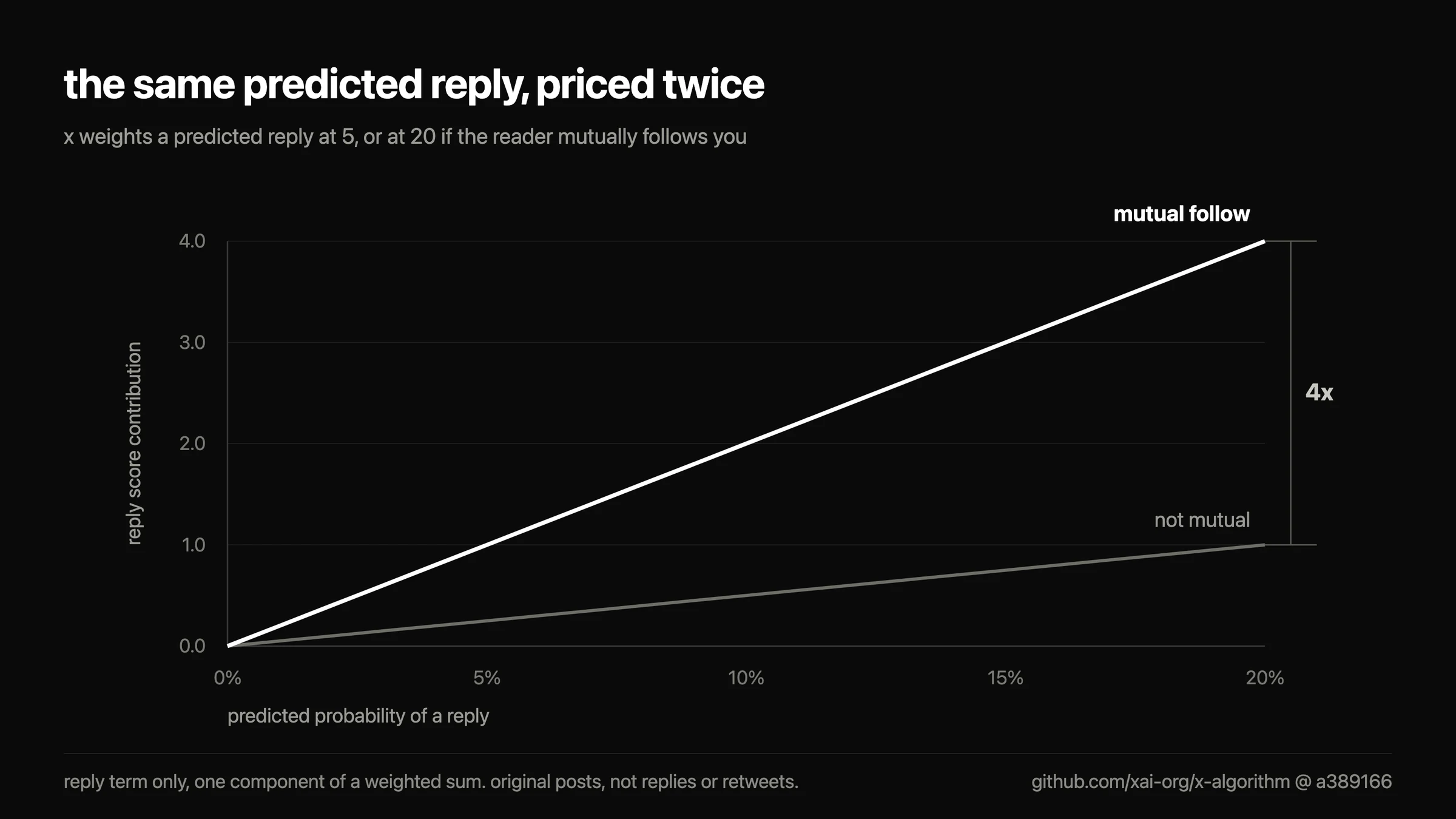
Both charts are generated by scripts/cards, from the same pinned commit. Drag it sideways to read it.The pinned commit
The record
- Read
- X's open-source For You algorithm, released 13 August 2026.
- Pinned to
- One upstream commit, a389166. Line numbers drift after it.
- Cites
- Twelve upstream files, each claim to a file and a line.
- Contains
- Ten findings, the full equation, a six-sheet model of 214 live formulas, two charts, and the scripts that rebuild them.
- Upstream licence
- Apache-2.0, quoted for commentary and not vendored.
- These notes
- MIT.
- Published
- github.com/julienaxyomlabs/x-algorithm-notes
- Status
- Reading notes. Not growth advice, and not affiliated with X.
If I can’t leave a thought alone, I make it real.
Some become products. Some become research. Some only needed to exist once.
Griotta is the one I’m building now.
julien@ombrise.com